AI Watermark Remover: Where the 'AI' Actually Is — and Where It Isn't
"AI watermark remover" is a category label, not an architecture. Search any of its three phrasings — watermark remover ai, ai remove watermark, remove watermark ai — and you land on the same set of tools, which run one of two very different engines: a cloud generative model (a real neural network; your file uploads, and the fill is generated), or a deterministic local fill algorithm (no model, no upload, repeatable results).
This tool is the second kind, and that is checkable in its code: the page's JavaScript contains no network calls (no fetch, XMLHttpRequest, WebSocket or sendBeacon), no randomness (no Math.random, Date.now or performance.now), and no neural-network runtime (no WebAssembly, ONNX, WebGL or WebGPU). The fill itself is Telea's Fast-Marching Method: guided by the mask you paint, it propagates pixels that already exist, weighted by the direction information flows from. The "AI" part is the input semantics and the guided reconstruction. The non-AI part matters just as much — there are no trained weights, which is exactly why your image never has to leave the device.
Below: what "AI" actually refers to in this category, where it lives in this tool, a three-check routine to classify any remover that uses the word, and the one place the label should change your decision.
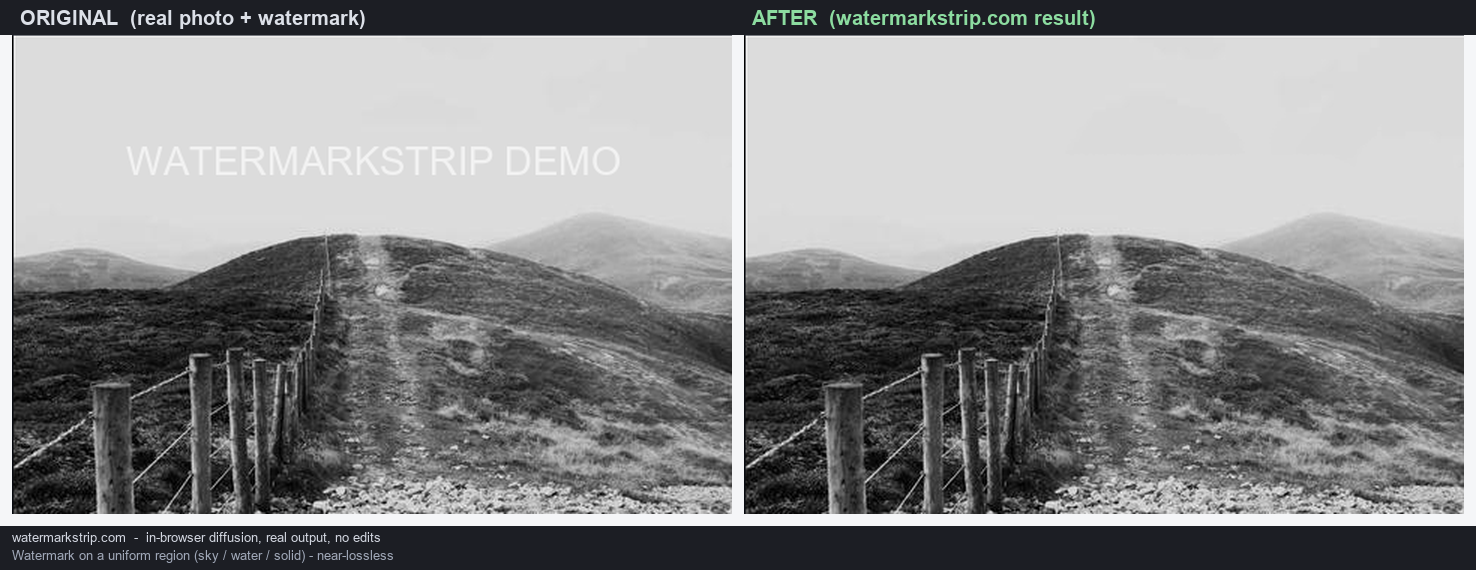
Three search phrasings, one category — and two engines inside it
People type this search three ways: watermark remover ai, ai remove watermark, remove watermark ai. The word order does not change what they mean — all three ask for a tool that takes a watermark out of a picture using machine intelligence. The category is real. What the label hides is that "machine intelligence" currently means two different things:
- Cloud generative inpainting. A diffusion-style model fills the marked area by generating plausible content. It is genuinely a neural network, it runs on the vendor's GPUs, and your image must travel to it. This is where the impressive before/afters usually come from.
- Local deterministic fill. A classical computer-vision algorithm — this site implements Telea's Fast-Marching Method — reconstructs the area by propagating existing pixels inward, guided by their gradients. No network round-trip, no trained weights, and the same input gives the same output on every run.
Which pixels end up in your result — propagated ones or generated ones — is its own question, covered separately in generative vs propagation removal. This page is about the label itself: knowing which engine sits behind an "AI" claim tells you three things before you commit anything — where your file goes, whether the result is reproducible, and whether the tool can ever work offline.
Where the AI actually is in this tool — and where it isn't
Stated at the code level, because that is the only level that does not inflate:
- The mask is the AI-style input. When you paint over the watermark (brush 4–120 px, default 24), you produce exactly the input an AI inpainting pipeline would take: an image plus a mask marking what to fill. The interaction model is the same as the cloud tools'. What differs is the engine behind it.
- The fill is guided reconstruction, not generation. The implemented algorithm is Telea's Fast-Marching Method: masked pixels are filled in order of distance from the boundary (a binary min-heap orders the frontier), and each new pixel is a weighted average of already-known neighbours, weighted by how well each neighbour's gradient points toward the target. Weights are clamped to non-negative, so information only flows from known pixels into the hole.
- There is no model runtime. A scan of the tool's JavaScript finds no WebAssembly, no ONNX, no WebGL, no WebGPU, no Worker, no
importScripts— nothing that could host a neural network in the page. - There is nothing random to hide behind. No
Math.random, noDate.now, noperformance.nowanywhere in the removal path. Two runs on the same image and the same mask produce pixel-identical output. If a tool's repeats differ, something sampled — and sampling means generation was in the loop. - There is no path to a server. No
fetch, noXMLHttpRequest, noWebSocket, nosendBeacon. The label says AI; the network tab says local.
So where is the intelligence? In the ordering and the weighting: the algorithm decides, per pixel, which neighbours deserve to influence the fill and by how much. That is computation over your pixels — not inference over learned priors from a training set. The distinction is honest, and it is testable, which is more than most labels in this category offer.
The word 'AI' in this category: accurate, inflated, and disclosed
Because the label sells, it gets stretched. In practice you will meet three uses of "AI" on tools in this space:
- Accurate. "AI watermark remover" describing a cloud generative model — a real network does the fill, and the honest trade-offs are upload, account or credit walls, and results you cannot reproduce.
- Inflated. "AI" bolted onto a classical algorithm — the engine is gradient- or patch-based fill, much like this site's, but marketed with model language, sometimes to justify a subscription.
- Label plus disclosure. A tool that wears the category label on its face and states the actual engine on the page. This site does that: the tool's own facts list calls the quality "In-browser diffusion fill" and adds, verbatim: "Not a cloud AI model — complex or large marks may leave a trace." Its FAQ answers "Is this an ai watermark remover that needs the internet?" with a plain "No."
The third usage is the one worth demanding as a reader: a label, plus one sentence of engine disclosure. Any tool that will not tell you which engine it runs — after you have looked for a paragraph — is telling you something by not saying it.
A three-check routine to classify any 'AI' watermark remover
Run this on any tool in the category, including this one. Under two minutes, no technical background:
- Check 1 — the network tab. Open DevTools (F12) → Network, load an image, run one removal. Any request that carries your image means a cloud engine, whatever the label says. This is the same 60-second upload test, used here as an engine classifier rather than a privacy check.
- Check 2 — the repeat test. Run the identical input and identical mask twice and compare the outputs. Byte-identical means the pipeline had no sampling step — deterministic fill. Differing outputs mean something generated, which means a model was in the loop.
- Check 3 — the offline test. Load the page, disconnect your network, run again. Still works = the "AI" never needed a server. Fails = the intelligence lives on someone else's GPU. It is the strongest single test and the hardest to fake; how it plays out on this tool is documented here.
Apply all three here and the classification agrees with the fine print: zero image-bearing requests, pixel-identical repeats, full function with the network off.
What the AI label should change for you — and what it shouldn't
Once you can classify a tool from its claim, the choice gets easier:
- Choose a cloud generative tool when the mark is large, complex, or sits over textured areas, and the image may be uploaded. That is where generated fills genuinely outperform propagation.
- Choose a deterministic local tool when the mark is small or simple and any of these matter: the image cannot be uploaded (IDs, client photos, unreleased material), the result must be reproducible, the tool must work offline, or the free tier must stay free rather than metered.
What the label should not change: your expectations about the physics. No engine — cloud or local — can recover pixels that were never captured. When a watermark covers a large area, every method is guessing; the difference is whether the guess comes from your own image's gradients or from a model's prior about what photos usually look like. A tool that admits this in plain language ("may leave a trace") is telling you the truth; read that as a good sign, not a weakness.
One more thing the label does not touch: legality. The engine type has no bearing on whether removing a given watermark is permitted — that depends on the mark and your rights to the image, covered with the actual statutes here.
FAQ
- Is this actually an AI watermark remover? It carries the category label — the page's own description reads "Free AI watermark remover that runs entirely in your browser" — and it discloses its engine just as plainly: a deterministic, gradient-guided local fill with no neural network and no cloud model. Both statements come from the page itself, and both are checkable in the code.
- Can AI remove a watermark from any image? No. Small or simple marks over smooth areas do best. Large or complex marks may leave a trace regardless of engine; a cloud model fills bigger holes more convincingly, at the cost of uploading your image and non-reproducible results.
- Why do people search "watermark remover ai", "ai remove watermark" and "remove watermark ai" differently? Same search, same category — the word order is just how it comes out. There is no separate "remove watermark AI" tool type; classify whichever tool you land on with the three checks above.
- Does "AI" mean my image gets uploaded? Not necessarily. The word describes the engine, not the plumbing — but in this category the strongest engines are cloud models, so upload is common. The only reliable answer is per-tool: run the network-tab check. On this site, the removal path contains no network calls at all.
- Is a deterministic fill worse than a "real" AI model? Only relative to a job. Deterministic fill is repeatable, private, free to run and works offline; it loses on large, textured or complex marks. The repeat test and the offline test tell you which kind you are holding.
- Why does this tool use the AI label if there is no model in it? Because the pipeline shape is the one AI inpainting uses — an image, a mask you paint, a guided fill — and because the page discloses exactly what the engine is and is not, verbatim: "Not a cloud AI model — complex or large marks may leave a trace." Label plus disclosure beats either alone.
- Does the AI label affect whether removing a watermark is legal? No. Generated or propagated, the pixels' origin is irrelevant to permission; what matters is the watermark, the source image and your rights in it.