Free AI Watermark Remover: What 'Free' Should Mean
Yes - this is a free AI watermark remover, and 'free' here means four things at once: no payment step, no account, the full-resolution result with no stamp, and no quiet trade of your data. The claim is checked in the code rather than asserted: a case-insensitive search of the tool's three files for billing vocabulary - price, pricing, billing, checkout, stripe, paypal, tier, trial, quota, license, token and more - returns zeros across the board. The only money-adjacent sentence in the entire project is the FAQ line denying that money exists: "Yes - no payment, no login, no credits. It is free to use in your browser."
Whether you searched "ai watermark remover free" or "free ai watermark remover", it is the same product question, and this page answers it in both directions: a 3-minute audit you can run on any candidate tool (including this one), and the receipt from running it here - fourteen money-strings at zero, zero network calls, zero storage - plus the honest list of what free does cost: your device does the work, one image at a time, no batch, no video, no auto-detect.
Below: the four commitments a free claim should mean, the audit steps, the table of zeros, and why this can stay free without a catch growing in later.
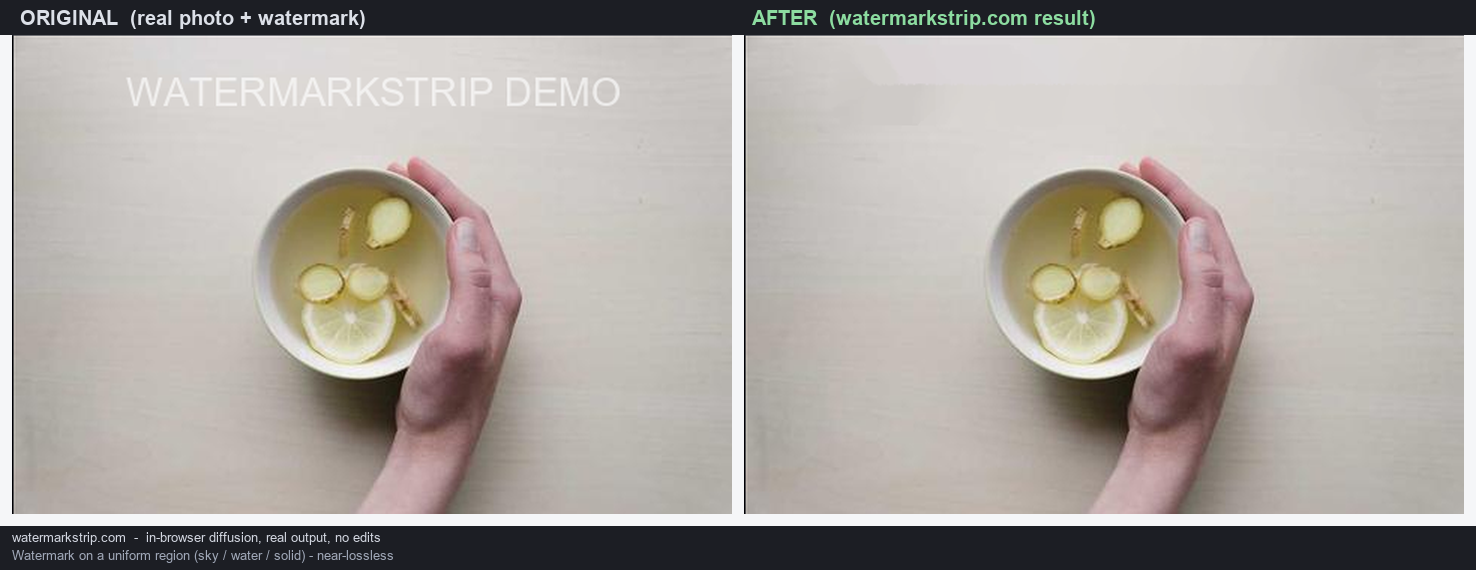
Two word orders, one product question
Type it either way - "free ai watermark remover" or "ai watermark remover free" - and you are asking the same thing: which tool removes watermarks, calls itself AI, and costs nothing. This page answers it for this site's tool with its code as evidence, because 'free' is exactly the kind of claim a page can make and a codebase can contradict.
The name has two halves and both deserve scrutiny. The AI half: every tool in this category calls itself AI, and they are not all the same kind of machine - some fill your marked area with a model, some propagate pixels you already have. That taxonomy is its own guide (where the 'AI' actually is, checked in the code), so this page stays on the free half: what the word commits a tool to, how to verify it in minutes, and what free costs when it is real.
What 'free' should mean: four commitments
Strip the marketing and 'free' in this category reduces to four testable commitments:
- No payment step. The removal itself never asks for money - not before, not after, not at export.
- No account. No signup between you and the result. An email gate is a payment in kind.
- The full result. The file you download is the whole image at full resolution, with no stamp added and nothing held back for a paid tier.
- No quiet data trade. Not charging money is not the same as being free. If your image is uploaded, retained or reused, you paid in data - the exact trade a genuinely free tool has no need to make.
These four matter because of the economics underneath. A cloud tool has a real per-image cost - GPU time on someone else's server - so its 'free' tier is a marketing budget, and when that budget runs out it tends to develop the catches the earlier free-removal guide catalogues (every catch, checked in the code). A tool with no per-image cost has no structural reason to develop catches at all. That difference is also what the audit below is designed to expose.
The 3-minute audit to run on any candidate
Run this before trusting any free claim, ours included:
- 1. Read the tool's own statement of what is free. A serious claim is specific. This site's homepage commits in one sentence: "Free AI watermark remover that runs entirely in your browser. No upload, no login, no signup. Remove logos, text, and stamps from images privately." Vague is a warning sign; checkable is the goal.
- 2. Search the code for money. Open DevTools (F12) and search all sources (Ctrl+Shift+F) for
price,billing,credit,quota,checkout. A truly free tool has nothing to find. If a hit appears, read its context - a string that never renders is noise; a counter that gates the remove button is the paywall. - 3. Watch one removal on the Network tab. Zero requests carrying your image means local processing and no per-use server cost. One upload means the 'AI' lives behind a paid API - which is precisely where free tiers get tight. (The full request-reading method: does it upload your image?)
- 4. Inspect the exit. Export the result. Full resolution? No added stamp? Both common formats available without a nudge? That is commitment three.
- 5. The offline test settles it. Load the page, disconnect, run one removal. Still works: processing is local and free was structurally easy. Fails: you were using a cloud API with a free sample attached.
Steps 2 and 3 take about three minutes combined. The offline test is the strongest single check, for the same reason it appears in all of our guides: a tool that cannot reach a network either works or it does not - and we ran it (with the Wi-Fi off, tested).
The receipt: this tool's code, audited on September 23, 2026
We ran the same audit on this site's own code - three files (app.js, index.html, styles.css), case-insensitive substring search. Seventeen money-related strings searched; fourteen returned zero occurrences: price, pricing, billing, checkout, stripe, paypal, charge, tier, trial, premium, subscribe, quota, license, token.
The three non-zero hits are worth reading, because each one is the audit passing rather than failing:
- payment: 1, credit: 1. Both inside the same FAQ sentence: "Yes - no payment, no login, no credits. It is free to use in your browser." (The bare substring
payalso hits exactly once - inside the word 'payment', same sentence.) The only money-adjacent sentence in the project is the denial. - upgrade: 1. A comment on line 1 of the stylesheet - readability upgrade. There is no paid tier to upgrade to.
The plumbing behind the four commitments, at code level:
- No payment step. The remove path is four beats: click Remove, a 30-millisecond pause so the status line can render, the fill, the download button appearing. No counter, no gate, no eligibility check runs before or after it.
- No account. No login, auth, signup or session code exists anywhere, and there is nothing to persist a session with:
localStorage0,sessionStorage0,indexedDB0, cookies 0. The facts panel says it in plain text: "Login: None. No account, no signup, no popup." - The full result. The canvas is created at the image's natural width and height - there is no downscale code - and one click exports it as
watermark-removed.pngorwatermark-removed.jpg, your pick, neither stamped, neither paywalled. - No quiet data trade.
fetch0,XMLHttpRequest0,WebSocket0,sendBeacon0; no random sources (Math.random0,Date.now0); no external runtimes (wasm0,WebGL0,WebGPU0). There is no code path over which data could leave, so there is no data to sell. Free here is not subsidised by your images, because your images never arrive anywhere.
You can reproduce every number above in about three minutes with the audit in the previous section. That is the point of publishing them.
The fill, named: Telea's Fast-Marching Method
Every tool in this niche calls itself AI, so the word on its own tells you nothing. This one's fill is a specific, named algorithm, and the source says which: "inpaint (Telea's Fast-Marching Method)" - the method OpenCV exposes as cv2.INPAINT_TELEA. The line beneath it describes the mechanism: "Fills the masked region by propagating known pixels inward, in order of distance from the boundary, weighting each source by how well its gradient points toward the target pixel."
That sentence is the whole difference between the two families of removers, and it decides what your result actually contains:
- Propagation (this tool). The area under your brush stroke is rebuilt from pixels you already had, pushed inward from the stroke's edge. Nothing is invented. The comment even records why the cheaper option fails here: "Jacobi diffusion alone cannot, because a uniform interior averages to itself."
- Generation (most cloud "AI" removers). A model predicts what it believes belongs there and paints it in. On a beach photo the result can look convincing - and the pixels in the filled area are the model's guess, not a continuation of your file.
Why that matters outside a seminar: for evidence, editorial, medical or legal-adjacent images, "the fill cannot invent detail that was not in the original" is a property you can lean on. A generative fill gives you no way to separate the pixels that came from your camera from the pixels that came from a model. This tool's answer is structural rather than a promise - there is no model in the path to invent anything.
The trade-off is printed on the tool page itself, not buried: "In-browser diffusion fill. Best on small or simple watermarks over smooth areas. Not a cloud AI model - complex or large marks may leave a trace." A named, limited method that admits its limits is more useful than an unnamed one that claims none. The full comparison, including the cases where a generative model genuinely wins, is in generative vs propagation watermark removal.
What free costs here - the honest part
Free is not costless. The costs are real; they just all land on your device instead of your wallet:
- Your hardware does the work. The fill runs on your CPU. Very large images slow down or hit browser memory limits - the tool's own warning past 40 megapixels: "Image is very large; processing may be slow or limited by browser memory." A cloud tool spends someone else's RAM; this one spends yours.
- One image at a time. "Batch: Not included. One image at a time." Fifty photos means fifty passes.
- Images only. "Process video files (images only in this build)" is listed under Can't.
- You mark the watermark yourself. No auto-detection - "Auto-detect watermarks without you marking them" is also a Can't. The brush, adjustable from 4 to 120 pixels, is the detection.
- Simple fills, honestly labelled. The page's own quality line: "In-browser diffusion fill. Best on small or simple watermarks over smooth areas. Not a cloud AI model - complex or large marks may leave a trace."
Why this can stay free without a catch growing in later: the marginal cost of a removal is zero. The math happens on your machine, nothing is stored, nothing is transmitted, so each additional user costs the site nothing. There is no server bill for a credit system to pay, and no pile of uploaded images to monetise. The header states the whole deal in six words: "Free, private, runs 100% in your browser." That is not generosity - it is what the architecture makes natural.
FAQ
- Is this ai watermark remover free to use? Yes - and the receipt above is the evidence: no billing code, no account system, no export limits. The tool's own FAQ answers it in one line: "Yes - no payment, no login, no credits. It is free to use in your browser."
- Is "free ai watermark remover" the same search as "ai watermark remover free"? Yes. Same words, two orders, one product question. Whichever you typed, the answer is the same checklist: four commitments, a 3-minute audit, a table of zeros.
- What's the catch? The costs are device-side and listed above: your CPU does the work, one image at a time, images only, you paint the mark yourself, and complex fills can leave a trace. The general catalogue of free-removal catches in this category - metered credits, stamped exports, trial clocks - lives in the earlier guide (Free Removal, No Catch?); this page does not repeat it, because a tool with no network code and no billing code has nowhere to put them.
- Do free AI watermark removers train on my images? A cloud one might retain and reuse uploads - read its privacy page, because a free tier has to be paid for somehow. This one cannot: with zero network calls and zero storage there is nothing retained, nothing aggregated, nothing to train on. Your image exists in one browser tab, and then it does not.
- Why do other free AI watermark removers run out of credits? Because their AI is a rented model: every removal costs the operator real money, and the free tier is a sample of a paid product. That is not a scam - it is GPU economics. It is also why the Network-tab check matters: if your image goes up, a bill eventually comes down.
- Will it still be free tomorrow? There is no billing code to switch on, no tier to upgrade into, no account system to meter against. Any of those would arrive as visible new code - so run the 3-minute audit on us again any time. The method is published precisely so it can be re-run.